
Pipe Fencing Contractor in North Texas: Ranch and Horse Pipe Fence Built and Welded On Site
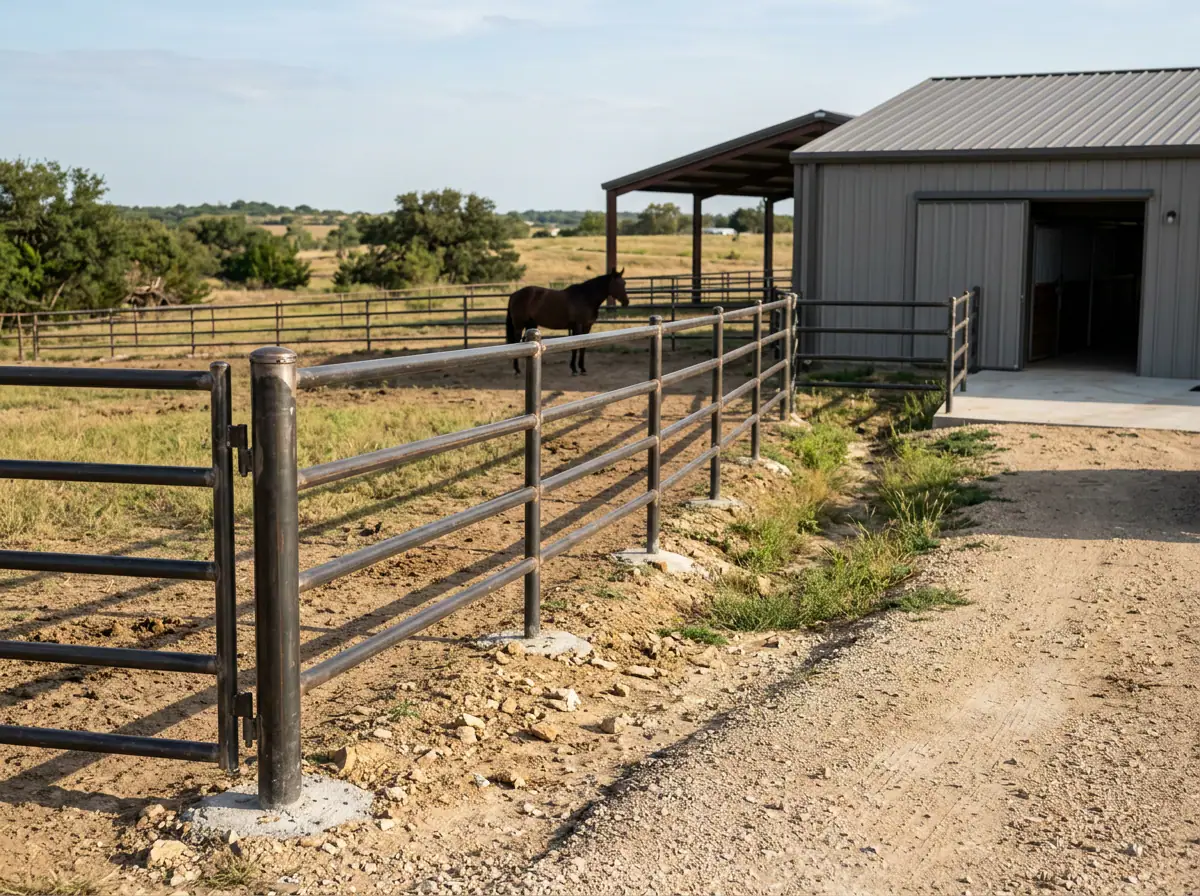
If you are looking for a pipe fencing contractor in North Texas, you have probably noticed how many crews will quote you a fence but have no idea what is going on with the rest of your property. Where the barn door swings, where water runs after a hard spring rain, and where the hay truck and horse trailer need to turn are all details that decide whether a fence works or becomes a daily annoyance. At Galvan Metal Building Services, we build and weld pipe fence on site, and we plan it alongside the arena, stall barn, or building we are already putting up.
This guide covers what we build, how the main fence styles compare, what to think about for horses, how North Texas ground changes the work, and what actually drives the price.
Why One Builder for the Fence and the Structures Makes Sense
Most fence problems on acreage are not fence problems. They are planning problems. A fence line gets set first, then a barn goes in and the gate lands in the wrong spot. Or a building goes up and the fence crew has to cut around a concrete apron they never saw on the plan.
Galvan MBS is owned and run by Lorenzo Galvan, who is also the foreman on the job. We self-perform steel erection, pour engineered concrete foundations, and coordinate the trades around them under one contract. When pipe fencing is part of that scope, the posts, gates, and runs get laid out with the structures, drainage, and traffic flow in mind from day one, not added later by a separate crew working from a rough sketch.
In practice that means fewer surprises: gates sized for the equipment that will actually use them, fence lines that clear slab edges and roof overhangs, and runoff that is not channeled toward a post line or a stall barn entry.
What Our Pipe Fencing Crew Builds
Pipe fencing covers a lot of ground, so here is how it typically breaks down for the properties we work on:
- Perimeter ranch pipe fencing: boundary and cross-fencing for acreage, built to hold up to livestock and daily use.
- Horse pipe fencing and paddocks: a horse paddock or turnout built with safe rail heights and clean finishing.
- Pipe and cable fence: pipe posts with a cable run between them, common on larger pastures.
- Fence around arenas and stall barns: pen lines, alleys, and turnouts that tie into the structure.
- Entry runs and ranch gates: the front entrance is often the first thing people see, so we treat it as a showpiece as much as a boundary.
The exact scope for your property gets confirmed at the site walk. You can see the range of work we do on our services page and browse real builds in the project gallery.
Welded Pipe Fence vs. Pipe and Cable Fence
The right style depends on what the fence has to do. Here is how we think about the three most common options.
Welded continuous pipe fence
A welded pipe fence uses line posts and corner posts with continuous horizontal pipe rails welded in place, including a top rail. It is a rigid, solid-looking fence that stays tight, and it is a popular choice for horse pens, working areas, and front entries where appearance matters. Because the rails are welded on site, we can adjust the fence to the grade and fit it cleanly to gates and corners.
Pipe and cable fence
Pipe and cable fence runs cable between pipe posts, which generally covers more footage for less material than full welded rails. It suits larger pastures and perimeter lines. Cable needs to be kept tight over time, and it is not always the best fit for pens where horses are tightly confined, so we usually reserve it for bigger runs rather than small paddocks.
Pipe posts with other infill
Some properties call for sturdy pipe posts with a different infill between them, such as wire or panels. This can make sense where you have a mix of animals or want to control cost across a long boundary while keeping strong corners and gates.
Which one fits which use
- Horses: welded pipe is generally the safest and cleanest option for paddocks and pens.
- Cattle: heavier pipe and tighter spacing hold up better, and a perimeter fence may mix styles.
- Show-quality front entry: welded pipe with a consistent top rail, clean welds, and a finished coating.
Horse Pipe Fencing: Safety Details That Matter
Horses are hard on fences, and a fence that looks fine can still be a hazard. These are general design considerations, not guarantees, since the right setup depends on your animals and how you handle them:
- Rail height: the top rail should be tall enough that horses are not tempted to lean over or try to jump it. Height depends on the horses and use, and we talk it through during the walk.
- Rounded tops and caps: exposed pipe ends are a problem. Posts should be capped or finished so there are no open or sharp edges.
- No sharp ends or protrusions: weld splatter, cut ends, and gate hardware should be dressed and finished so nothing snags a halter or a hide.
- Spacing: rail spacing and post spacing affect whether a horse can get a hoof or a head caught. Tighter, more consistent spacing is the goal in pens and turnouts.
- Gates and latches: they should swing freely, latch securely, and be placed where you can handle a horse safely.
Weatherford is known as the Cutting Horse Capital of the World, and a lot of our customers are working equestrians who care about these details. If you are building or expanding a horse facility, our horse arena and stall barn builds are designed to work hand in hand with the fence around them.
Building Fence in North Texas Ground
This is where local experience matters. Soil in Parker County and the surrounding area changes from one property to the next, sometimes within the same pasture. Around Weatherford, Millsap, and Stephenville, it is common to hit a mix of clay that swells and shrinks with moisture and rocky ground that makes digging slow.
- Clay soils: they move as they wet and dry, so posts need to be set deep enough and with proper concrete to stay plumb and keep the fence line straight.
- Rocky ground: post holes can take much longer to drill, and the work may need heavier equipment. That affects both the schedule and the cost.
- Drainage and low spots: water that collects along a fence line can undermine posts over time, so we plan around it.
Concrete-set posts, especially at corners, gates, and any high-load points, are what keep a pipe fence tight over the long run. When you ask a contractor about install time, the soil is usually the biggest variable, which is why we like to walk the fence line before giving you a schedule.
What Drives Pipe Fence Cost Per Foot
Everyone wants a pipe fence cost per foot, and we get why. The honest answer is that it varies a lot from property to property, so we price from your actual layout instead of quoting a number sight unseen. Here is what moves the price:
- Total footage: longer runs cost more overall, though setup costs spread out over distance.
- Pipe size and wall thickness: heavier pipe costs more and holds up better to livestock.
- Post spacing: closer spacing uses more posts and concrete.
- Terrain and clearing: brush, trees, slopes, and rocky ground add time and equipment.
- Number and size of gates: ranch gates and entry gates are a significant part of the total.
- Paint or coating: the finish you choose affects both appearance and long-term upkeep.
- Access: if trucks and equipment can reach the line easily, the job moves faster.
Our quotes are written clearly so you can see what is included, and we will tell you plainly if something like clearing is outside the scope.
Pairing Pipe Fence with an Arena, Barn, or Building
This is the part we think is most overlooked. If you are putting in a covered horse arena or a stall barn, the fence should be planned at the same time. That lets us line up pens and turnouts with barn doors, leave proper clearance for equipment and trailers, and avoid trenching or digging through a fresh slab.
The same logic applies to other buildings. A workshop or storage building on a working ranch needs a gate and driveway that fit the equipment going in and out. Planning that together saves rework and money later. You can read more about how we operate on our about page.
How the Process Works
- Site walk: we walk the property with you, look at the ground, and talk through animals, gates, and traffic flow.
- Layout and staking: we mark the fence line, corners, and gate locations so you can see it before work begins.
- Material order: pipe, posts, gates, and hardware get ordered based on the final layout.
- Post setting: posts are set and concrete is placed, starting with corners and gates.
- Welding: rails and gates are welded on site by our certified welder.
- Finishing: welds are dressed, caps are installed, and coating is applied where it is part of the scope.
- Walkthrough: we go over the finished fence with you before we call it done.
Service Area for Pipe Fence Contractor Work in Weatherford, TX and Beyond
We are a metal fencing contractor serving Parker County and the surrounding region. That includes Weatherford, Aledo, Azle, Springtown, Millsap, Mineral Wells, Granbury, Stephenville, Decatur, Cleburne, Burleson, and Fort Worth, plus properties within about 80 miles. If you are not sure whether your property is in range, just ask.
Pipe Fencing FAQ
How long does it take to schedule and build a pipe fence?
It depends on footage, soil conditions, material availability, and our current schedule. We give you a realistic timeline after the site walk, once we have seen the ground.
Can you tie into an existing fence?
Often yes, depending on the condition and type of the existing fence. We check it during the site walk and tell you what can stay and what should be replaced.
Is the fence painted or coated?
Coating and paint options can be part of the scope. We talk through the finish you want and what it means for upkeep and cost.
Is clearing included?
That depends on the property. Brush, trees, and grading are scoped at the quote so you know exactly what is and is not included.
Do you also build the arena or barn?
Yes. We build covered horse arenas, stall barns, and other metal buildings, and we plan the fence together with them when both are part of the project.
Walk the Fence Line With Us
If you want a pipe fencing contractor in North Texas who will plan your fence around the whole property, not just the footage, let us walk it with you. Start a quote or call or text 682-560-3469 with your acreage, approximate footage, and whether you are also planning an arena or barn. You will talk directly with the builder, not a call center.